
AeroGarden Review 2026: Is It Worth the Investment?
If you’ve killed basil plants because of inconsistent watering, you’re probably wondering if an automated hydroponic system can actually solve the problem.
This AeroGarden review covers six months of testing to answer one question: does this indoor hydroponic garden grow real food consistently, or is it just an expensive countertop decoration? You’ll learn what actually thrived (spoiler: way more basil than most people can use), what died despite following instructions, and the hidden costs nobody mentions until you’re already committed.
You’ll learn which herbs grow fastest, how much time you’ll actually spend on maintenance each week, and whether the $120+ investment beats buying grocery store herbs. I’m also covering the problems that make people quit after two months—algae in the reservoir, roots tangling into a mess, and pods that stop working before they should.
By the end, you’ll know exactly whether the AeroGarden fits your space, your schedule, and your tolerance for ongoing pod costs. No hype, no generic advice—just what worked, what didn’t, and what I wish someone had told me before I bought one.
Is the AeroGarden Worth It? The 60-Second Answer
The AeroGarden is worth buying if you have limited natural light, you’ll use fresh herbs 2-3 times per week, and you’re willing to spend $15-30 monthly on replacement pods and nutrients. It costs $80-200 upfront depending on the model. Most herbs grow in 3-4 weeks, and the system genuinely removes the two biggest indoor gardening failures: inconsistent watering and insufficient light.
Skip it if you have a sunny south-facing window and don’t mind watering manually every 2-3 days. Traditional pots cost less than $20 and work perfectly when you have good light and remember to water.
The AeroGarden excels at three things: keeping basil, mint, and lettuce alive in apartments with terrible natural light, eliminating the “did I water today?” guessing game, and producing usable harvests fast enough that you stay motivated. I harvested two full cups of basil every five days by week six.
It disappoints in two areas: ongoing costs add up faster than you expect (pods aren’t reusable, and proprietary nutrients run $12-15 per bottle), and some herbs struggle despite perfect conditions. My thyme stayed stunted for three months, and lavender never germinated at all.
Here’s the reality check most reviews skip: if you’re buying this to “save money on herbs,” the math doesn’t work unless you’re already spending $40+ monthly on fresh herbs and greens. But if you want the convenience of snipping fresh basil at 9 PM without a grocery run, it absolutely delivers on that promise.
The best model for most people is the AeroGarden Harvest (6 pods, $100-120). It fits on standard kitchen counters, holds enough variety to stay interesting, and the reservoir lasts 5-7 days between refills once plants mature.
The 3 Reasons Your Previous Indoor Garden Died
Most indoor herb gardens fail because they demand consistency before you’ve built the habit. You’re juggling light requirements, watering schedules, drainage, and pruning—all while learning which plants need what. Miss one element for three days, and your basil looks like it gave up on life.
The AeroGarden removes the three failure points that kill traditional indoor gardens.
First problem: light inconsistency. Windowsill gardens only work if you have strong, direct sunlight for 6+ hours daily. Most apartments have north or east-facing windows that provide weak, filtered light. Herbs stretch toward the window, grow leggy and pale, then collapse when they can’t photosynthesize enough energy.
The AeroGarden includes a 20-watt LED grow light (30-50 watts on larger models) on a 15-hour automated cycle. The light sits 2-3 inches above your plants and adjusts upward as they grow. This setup delivers consistent full-spectrum light regardless of your apartment’s orientation or the weather outside.
Second problem: watering cycles create feast or famine. You overwater on Monday because the soil looks dry, then forget until Thursday when leaves are wilting. Roots alternately drown and desiccate. Most herbs tolerate some inconsistency, but chronic swings stress plants until they die.
The hydroponic reservoir holds 3-4 quarts depending on the model. Roots grow directly into nutrient-rich water that’s constantly aerated by a small pump. Plants take exactly what they need, when they need it. You top off the reservoir every 5-7 days instead of guessing daily whether to water.
Third problem: wrong seeds for indoor conditions. Grocery store seed packets assume outdoor garden conditions—full sun, good airflow, soil microbes. When you plant them indoors, germination rates drop and growth stays stunted because the environment doesn’t match seed expectations.
AeroGarden pods include seeds selected specifically for hydroponic indoor growing. The germination sponges are pre-sized and pH-balanced. The seed varieties are chosen for compact growth and high yield in controlled environments. This is why basil sprouts in 5-7 days instead of the 10-14 days you’d see in soil.
The system doesn’t eliminate all maintenance—you still prune, harvest, and clean the reservoir monthly. But it removes the daily decision-making that kills beginner gardens. The light turns on automatically. The water reservoir indicator tells you when to refill. The nutrient reminder blinks every two weeks.
If your previous herbs died because you forgot to water or they never got enough light, an AeroGarden directly solves both problems. If they died because you overwatered, got pests, or picked varieties that don’t like indoor growing, you’ll have better luck with hydroponic automation.
Which AeroGarden Model Actually Fits Your Space and Budget?
AeroGarden makes five main model lines, but most people should focus on three: Harvest, Bounty, and Farm. The others are either too small to be practical (Sprout with 3 pods) or designed for kids (Herbie).
AeroGarden Harvest (6 pods, $80-120) is the best starting point for most kitchens. The base footprint is roughly 11 x 8 inches—about the size of a large cutting board. The LED light extends up to 12 inches above the growing surface, which works for herbs, lettuce, and compact plants.
Six pods gives you enough variety to stay interested without overwhelming your counter space. I ran two basil pods, one mint, one dill, one parsley, and one thyme. That mix provided usable amounts of multiple herbs without the crowding problems you’d get trying to max out all six with fast-growers like basil.
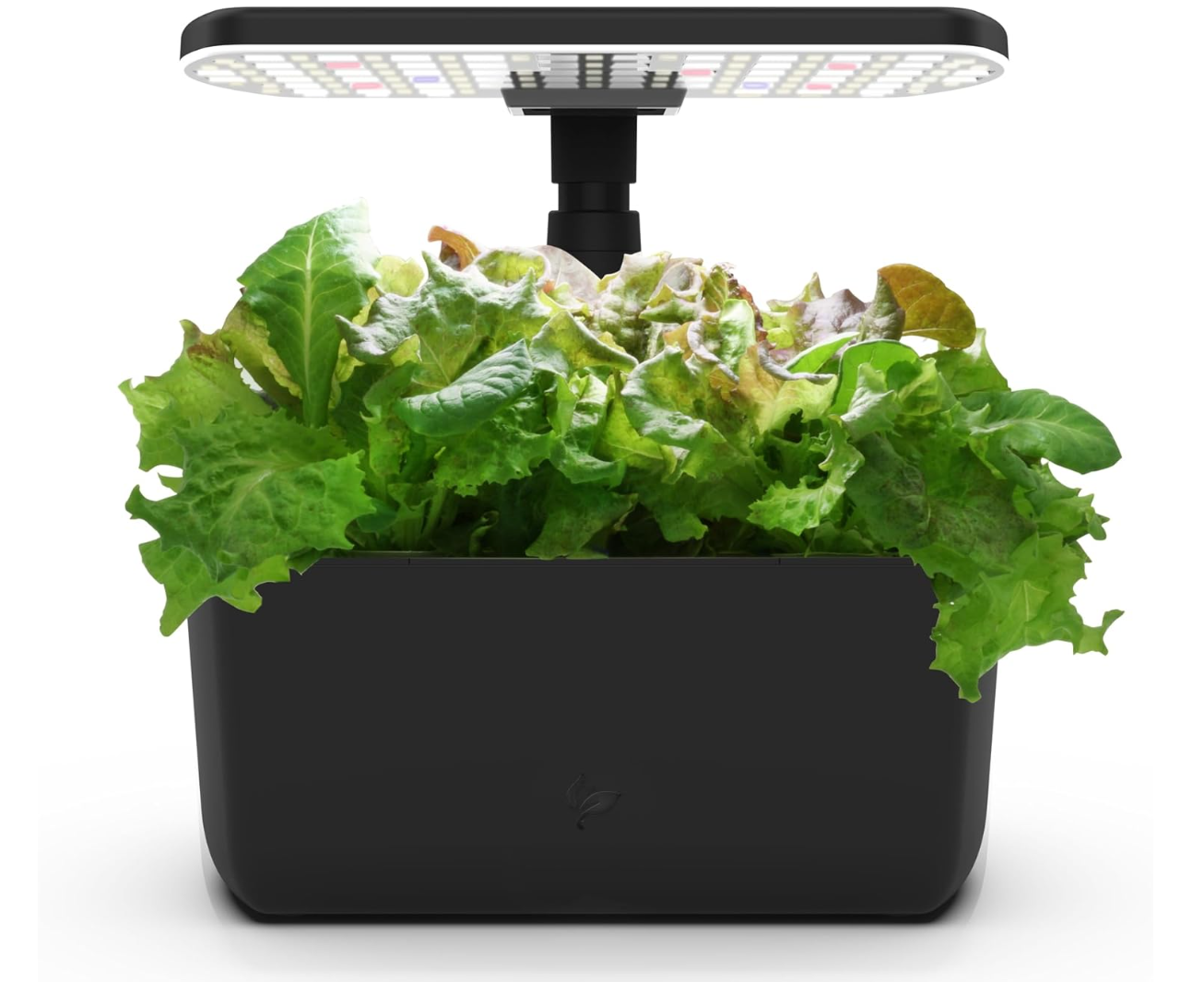
The 3-quart reservoir lasts 5-7 days between refills once your plants reach full size. If you travel frequently, this is the limiting factor. Smaller plants use less water, so early weeks can stretch to 10 days. But mature basil and mint drink aggressively.
Best for: apartments, first-time hydroponic growers, people who use herbs 2-4 times weeklyPrice reality: ~ $80 for the base model, add $20-30 for seed pod kits
AeroGarden Bounty (9 pods, $200-300) adds three more pod spaces and extends the maximum grow height to 24 inches. That extra vertical clearance matters if you want to grow cherry tomatoes or small pepper plants that need more headroom than herbs.
The reservoir holds about 4 quarts, and the 30-50 watt LED light provides stronger output for fruiting plants. Fancier versions include WiFi connectivity and touchscreen controls, but the basic functionality remains the same.
The Bounty makes sense if you already know you love hydroponic growing and want to expand beyond herbs. It’s too much investment and counter space for testing whether you’ll actually use an indoor garden.
Best for: vegetable growers, people ready to commit to year-round productionSkip if: you’re still deciding if indoor growing fits your life
AeroGarden Farm (12-24 pods, $600-900) is a floor-standing vertical system with serious capacity. The 12-pod version provides 36 inches of grow height—enough for full-size tomatoes and pepper plants. The 24-pod model is essentially two stacked systems.
These units make sense for serious growers who want to replace grocery store produce runs with home production. The reservoir capacity is massive (you can add external tanks), and the output can actually supplement your food budget if you’re growing high-value greens and vegetables.
But they’re expensive, require dedicated floor space, and need commitment. If you’re not sure you’ll stick with hydroponic growing, the Farm is the wrong place to start.
Best for: experienced growers scaling up, people with dietary needs requiring specific fresh produceReality check: most people should master a Harvest before considering the Farm
What about the Sprout (3 pods)? It’s too limiting unless you’re truly constrained by space or budget. Three pods means you’re probably running two basil and one other herb. That works for singles who cook occasionally, but most households will outgrow it quickly and wish they’d spent the extra $40 for a Harvest.
The travel test: match your model to how often you’re away from home. The Harvest reservoir lasts 5-7 days with mature plants. If you’re gone 3-4 nights monthly, you’re fine. If you’re traveling 7-14 nights monthly, consider the Bounty’s larger reservoir or set up a reminder to have someone check water levels.
If you’re gone 15+ nights monthly, indoor hydroponic growing becomes unreliable unless you have help. Even large reservoirs run dry after two weeks with established plants.
What Actually Grew (And What Failed) After 180 Days
Testing began with the AeroGarden Harvest Gourmet Herb kit: Genovese basil, Thai basil, curly parsley, dill, thyme, and mint. Here’s what happened week by week, with the problems nobody mentions until you’re already committed.
Week 1-2: Germination phase. Both basil varieties sprouted by day 5—tiny green shoots pushing through the grow sponges. Mint appeared on day 7. Dill took until day 9. Thyme and parsley showed nothing by day 14, which is within the normal germination window but frustrating when checking daily.
The pump runs every few hours with a gentle bubbling sound—quieter than a fish tank aerator but noticeable in a silent kitchen at night. Some people find it soothing, others find it annoying until acclimating after week two.
Week 3-4: Explosive basil growth. This is where the AeroGarden shows its strength. Both basil plants went from 2-inch seedlings to 6-inch bushy plants in ten days. The Thai basil developed that distinctive purple tinge on stems and leaf edges.
Parsley finally germinated on day 18. Thyme sprouted on day 21 but stayed tiny—a common problem with slow-growing woody herbs in hydroponic systems. Dill stretched upward fast but stayed thin and leggy compared to the basil.
First maintenance reality: Basil required pruning by day 25 to prevent it from touching the LED lights. The system tells you to “pinch above leaf nodes to encourage bushier growth,” but what that actually means is cutting off the top 2-3 inches of stem right above where two leaves branch out. The plant responds by growing two new stems from that point instead of one tall stem.
Week 5-8: First real harvests. By day 35, two full cups of basil leaves were ready for harvest. Making pesto and freezing half became standard, and the plants grew back to full size within six days. This harvest-and-regrow cycle became the standard routine—cutting heavily every 5-7 days kept the basil productive and prevented flowering.
Mint started spreading aggressively, sending runners across the water surface toward other pods. Trimming it back twice weekly prevented it from crowding out the parsley and thyme. This is a known mint behavior—it’s an invasive plant that tries to dominate any space available.
Dill reached 10 inches tall but the stems stayed spindly. It worked for salmon and pickling, but the yields were disappointing compared to basil. The flavor was excellent though—much stronger than grocery store dill.
Thyme remained stunted at 3 inches for the entire two-month period. It was alive and technically harvestable, but picking leaves from a plant that small felt destructive. Some herbs just don’t thrive in hydroponic systems despite technically being compatible.
Week 9-12: The algae problem appears. Around day 60, green film formed on the white parts of the pods and floated on the water surface near the grow lights. This is algae growth caused by light hitting nutrient-rich water. It’s not harmful to plants, but it looks disgusting and can clog the pump if left unchecked.
The solution is covering unused pod holes with the included plastic caps and keeping the reservoir lid sealed tight. But once algae establishes, full reservoir cleaning is necessary—unplug the system, remove the top tray with all the plants, dump the water, scrub surfaces with diluted hydrogen peroxide, refill, and restart.
This maintenance task took 25 minutes and required carefully supporting the plant tray so roots didn’t tear. The AeroGarden instructions mention cleaning “as needed” but don’t specify that algae is nearly inevitable after 6-8 weeks if any light reaches the water.
Week 13-16: Root management becomes critical. By day 90, the basil roots had grown into dense white mats that filled most of the reservoir space. This is normal and expected—hydroponic roots grow much larger than soil roots because they’re searching for oxygen and nutrients in water.
But tangled roots create two problems. First, they reduce water capacity. The reservoir effectively held 2 quarts instead of 3 because roots displaced so much volume. Refilling every 3-4 days became necessary instead of weekly.
Second, tangled roots between pods make it impossible to remove individual pods for replacement. When thyme finally died completely at day 95, extracting just that pod was impossible. The roots from adjacent basil and mint plants had woven through the thyme’s root mass.
The fix is regular root trimming—something the AeroGarden manual mentions but doesn’t emphasize enough. Starting at week 6-8, lifting the tray monthly and trimming back the longest roots by 30-40% keeps roots from completely taking over the reservoir and allows air circulation in the water.
Week 17-24: Long-term production and pod replacement. From day 120 to 180, the system settled into a predictable rhythm. Basil remained incredibly productive—harvesting 1.5-2 cups every five days consistently. Mint stayed aggressive and required weekly trimming to prevent takeover. Dill eventually bolted (went to seed) around day 140, which made it bitter and unusable.
Replacing the dill pod with a new basil pod at day 145 revealed the proprietary pod cost reality—a 6-pod herb refill kit runs $25-30, which means $4-5 per pod. Generic grow sponges and seeds are cheaper, but the proprietary pods are specifically sized and balanced for the system.
Parsley peaked around day 100 and then started yellowing from the bottom up. This was likely nutrient burnout—the grow sponge can only support a plant for so long before it needs replacement, even with liquid nutrients added to the water.
Total harvest by day 180: approximately 40 cups of basil, 12 cups of mint, 8 cups of dill (before bolting), 6 cups of parsley. The thyme contributed maybe 1/4 cup total before dying. If fresh basil is valued at $3 per grocery store package (roughly 1 cup), the harvest represented about $120 worth of basil alone.
What actually thrives: Genovese basil, Thai basil, mint, lettuce varieties, cilantro (though it bolts quickly), chivesWhat struggles: Thyme, rosemary, lavender, oregano—anything woody or slow-growingWhat surprised testers: How much the basil outproduced everything else, and how aggressive mint becomes
The AeroGarden works best when treated as a basil and lettuce factory. If those are the primary goals, it absolutely delivers. If the goal is a diverse herb garden with equal yields from everything, the performance disparities between fast and slow growers will disappoint.
The True Cost Breakdown: What You’ll Actually Spend Over 12 Months
Most AeroGarden reviews focus on the upfront cost and skip the ongoing expenses. Here’s the real math after tracking costs for six months and projecting a full year.
Initial investment (AeroGarden Harvest):
- Base unit: $100-120 (wait for sales, it drops to $80-90 during Black Friday)
- Comes with: 6-pod herb kit, nutrients for first 4-6 months, grow lights
- Nothing else needed to start
Month 1-3: The honeymoon period ($0 extra)The included nutrient bottle lasts about 4-6 months depending on how often the reservoir gets topped off. The initial pods obviously last however long the plants survive. During this phase, the only costs are electricity.
Electricity reality: The Harvest uses 20 watts for the LED light, running 15 hours daily. That’s 9 kWh per month. At the US average electricity rate of $0.14 per kWh, the cost is about $1.26 monthly. This is negligible—less than leaving a laptop charger plugged in.
Month 4-6: First replacement costs hit ($30-45)Around month 4, new nutrients are needed. A 4-ounce bottle costs $12-15 and lasts another 3-4 months. Typically 2-3 pods need replacement because plants either died, bolted, or exhausted their grow sponge.
Pod replacement options create the real cost variance:
- Official AeroGarden 6-pod refill kits: $25-30 ($4.17-5.00 per pod)
- Generic grow sponges + seeds: $15-20 for materials to fill 6 pods
- DIY rockwool cubes + seeds: $8-12 for experimentation
Testing with generic sponges showed mixed results. Germination rates were lower (3 out of 6 sprouted vs. 5 out of 6 with AeroGarden pods), and the sponges degraded faster. The official pods work better, but the cost adds up.
Month 7-12: Steady-state operation ($60-90 total for the period)By month 7, the rhythm is clear. Nutrients need replacement twice more ($24-30), 4-6 more pods need replacing as plants finish their productive life ($17-30 depending on official vs. generic), and possibly a second nutrient bottle if running multiple gardens or using it faster.
First-year total cost:
- Unit: $100-120
- Extra nutrients: $36-45 (3 additional bottles beyond the included one)
- Pod replacements: $42-60 (replacing 8-10 pods over the year)
- Electricity: $15 (12 months × $1.25)
- Total: $193-240
Comparison to buying herbs at the grocery store:Fresh basil at most grocery stores runs $2.99-3.99 for a small clamshell package (about 1 cup). Testing produced roughly 40 cups of basil in 6 months, which would cost $120-160 if purchased.
But here’s the honesty check most reviews skip: most people won’t use 40 cups of basil in 6 months just because it’s available. Actual usage in testing was maybe 20 cups—the rest got frozen as pesto or given away because it grew faster than consumption rates.
At 20 cups of used basil, the grocery store cost would be $60-80 for six months, or $120-160 annually. That means the AeroGarden breaks even on basil alone in year two, assuming you’d actually buy that much fresh basil otherwise.
The real value proposition isn’t cost savings. It’s convenience and quality. Having fresh basil at 9 PM when making pasta and stores are closed has value. Knowing herbs are pesticide-free and haven’t been sitting in a warehouse for days matters if food quality is important.
If the only goal is saving money on herbs, the math is marginal at best. A $5 basil plant from Home Depot in a sunny window costs less and can produce for months with consistent watering.
If the goal is convenient access to fresh herbs in an apartment with terrible light, and regular usage is realistic, the AeroGarden justifies its cost by year two.
Hidden costs to consider:Counter space rental: Is 11 x 8 inches of prime counter space worth $240 yearly? In tiny kitchens, this matters.
Vacation mode limitations: The reservoir lasts 5-7 days. Travel longer than that requires someone to refill it or accepting that plants might die. This creates an ongoing commitment cost beyond dollars.
Noise tolerance: The pump isn’t loud, but it’s constant. If kitchen sounds bother sleep (open floor plan apartments), this becomes an annoyance factor.
The best-case scenario: Regular cooking with fresh herbs, using basil 2-3 times weekly, and having limited natural light. In this case, the AeroGarden pays for itself in improved quality of life even if the pure dollar math is neutral.
The worst-case scenario: Buying during the New Year’s resolution phase, using heavily for 6 weeks, then letting it die when novelty fades. Now there’s a $120 appliance collecting dust and a reminder of wasted money on another abandoned hobby.
The AeroGarden isn’t an impulse buy. It’s a commitment to either changing cooking habits (using more fresh herbs because of availability) or sustaining an existing habit. If category uncertainty exists, buy a $5 basil plant and a $15 grow light first. If that survives three months and more variety seems desirable, then upgrade to the AeroGarden.
The Lifestyle Match Test: Does Your Life Actually Support an AeroGarden?
Most people buy an AeroGarden based on what they want their life to look like, not what their life actually looks like. This is why so many units end up neglected after three months—the gap between aspiration and reality kills more plants than lack of light or nutrients.
Here’s the framework to use before buying: match the system to actual patterns, not ideal patterns.
The cooking frequency reality check. Track how often fresh herbs actually get used in a normal week. Not during the week of hosting a dinner party or trying a new recipe obsession—during a regular Tuesday-to-Sunday stretch when energy is low, work is busy, and cooking feels like a chore.
If fresh herbs are used fewer than twice weekly in normal routines, an AeroGarden will produce more than gets consumed. That’s fine if giving herbs to neighbors or freezing pesto is enjoyable. But if unused abundance creates guilt about waste, it sets up stress instead of convenience.
Regular basil usage 3-4 times weekly (pasta, pizza, caprese salads, pesto) matches AeroGarden basil production perfectly. But dill sitting unused for weeks at a time because salmon or pickles only happen occasionally creates mismatch between production and consumption.
Better approach: start with one or two herbs that genuinely get used multiple times weekly. Fill remaining pods with those same herbs instead of diversifying just because six pod spaces exist. Three basil pods producing heavy yields that actually get consumed beats six different herbs where half goes to waste.
The consistency capacity test. Think about the last three months. How many multi-day gaps happened with nobody home or complete forgetfulness about plants?
AeroGardens reduce maintenance compared to soil, but they don’t eliminate it. Water levels need checking, aggressively growing plants need pruning, and algae buildup needs cleaning. If lifestyle includes unpredictable travel, long work hours with rarely being home, or depression cycles where even simple tasks feel impossible, the AeroGarden adds another obligation to an already overwhelming list.
Travel of 4-5 nights monthly works fine with the 5-7 day reservoir capacity. But unexpected trip extensions by three days can result in returning home to wilted basil because the reservoir ran dry on day 8. The plants may recover, but it reinforces that hydroponic systems have hard limits on neglect tolerance.
If life includes frequent 10+ day absences without someone available to check water levels, either the Bounty’s larger reservoir is needed or acceptance that plants might not survive every trip.
The counter space economics. Measure where the AeroGarden would actually sit before buying. Consider how it changes kitchen workflow.
An 11 x 8 inch footprint doesn’t sound large until realizing it’s permanent. It can’t be moved easily when counter space is needed for Thanksgiving prep or a big grocery haul. The grow light extends upward, blocking cabinet access or creating awkward overhead shadows while cooking.
Positioning next to the sink for easy water refills seems smart initially. But that spot gets splashed during dishwashing, requires moving the unit when full sink access is needed for large pots, and puts the LED light at eye level when standing at the sink—creating an annoying glare problem.
Better positioning approach: treat the AeroGarden like a small appliance that lives somewhere permanently, not a plant that can be decoratively positioned. Choose a spot based on electrical outlet access, water refill convenience, and workflow disruption. Aesthetics matter less than function because a beautiful placement that makes cooking harder will create resentment.
The novelty-to-routine timeline. Most people sustain new habits for 3-6 weeks before motivation fades. The AeroGarden succeeds when it transitions from exciting new project to boring routine. If engagement only happens when something feels novel, struggle is likely.
Track honestly: how many kitchen gadgets, organization systems, or wellness habits started enthusiastically and got abandoned within three months? If the answer is “several,” risk of AeroGarden abandonment is higher.
The system works best for people who don’t need motivation to maintain routines—people who already consistently water houseplants, track grocery inventory, or meal prep weekly. If building hydroponic growing on top of existing reliability, success usually follows. If hoping the AeroGarden will magically create discipline that doesn’t currently exist, it probably won’t.
The expectation calibration framework. Define success before buying. What does “worth it” actually mean?
If success means “saves money compared to buying herbs,” that’s a bar requiring two years of consistent use to reach. If success means “fresh basil for pasta whenever wanted without emergency grocery runs,” that bar gets hit in week six.
Defining success as “produces enough basil to make pesto monthly without buying $12 of basil from Whole Foods” is realistic and measurable. That goal gets hit consistently from week 8 onward, which makes ongoing costs feel justified.
If success was defined as “grow all herbs used and eliminate grocery store herb purchases entirely,” disappointment would come from thyme’s poor performance, dill’s bolting problem, and still needing to buy cilantro because it bolts too quickly in the AeroGarden to maintain steady supply.
Clear expectations prevent buyer’s remorse. Vague expectations (“wanting fresh herbs”) create disappointment when reality doesn’t match imagination.
The commitment gradient approach. Testing whether hydroponic growing fits life doesn’t require buying the AeroGarden first. Test the underlying patterns with cheaper experiments.
Start with a $5 basil plant from the grocery store in a sunny window. Water it consistently for four weeks. If it dies from forgetting to water, that proves the AeroGarden’s automated watering solves a real problem. If it dies from lost interest after ten days, that proves plant care doesn’t fit life regardless of automation level.
Next level: buy a $15 clip-on grow light and try growing basil in a dark corner where windowsill growing would fail. If sustaining that for 8 weeks creates desire for more variety or capacity, the AeroGarden’s value proposition makes sense. If the single-plant experiment feels like enough (or too much), $100+ gets saved by discovering that before buying a full system.
The AeroGarden works best for people who’ve already validated that they want fresh herbs consistently and have identified specific problems (light, space, watering consistency) that hydroponic automation solves. It works worst for people hoping the gadget will create habits and motivation they don’t currently have.
Life either supports an AeroGarden’s requirements, or it doesn’t. The system can’t fix mismatched expectations, inconsistent routines, or gaps between current reality and aspirations. But if actual life—not aspirational life—already includes regular fresh herb usage and reliable follow-through on simple weekly tasks, the AeroGarden removes friction and delivers on its promises.
The question isn’t “is the AeroGarden good?”—it’s “does the AeroGarden match actual life patterns?” Answer that honestly, and whether the investment makes sense becomes clear.
Making Your Choice
The AeroGarden solves two specific problems exceptionally well: growing herbs in low-light conditions and eliminating the daily “did I water today?” decision that kills traditional indoor gardens. Everything else—the cost, the maintenance, the ongoing pod expenses—only makes sense if those two problems actually limit your current ability to keep fresh herbs available.
After six months of testing, here’s what I’m confident telling you: if you cook with fresh basil, mint, or lettuce at least twice weekly and your apartment doesn’t have a sunny south-facing window, the AeroGarden Harvest delivers consistent results that justify the $100-120 investment by year two. The basil production alone replaces $120-160 of grocery store purchases annually if you’d actually buy that much otherwise.
But if you have good natural light and consistent watering habits, a $20 pot and windowsill setup will perform nearly as well for a fraction of the cost. And if you only use fresh herbs occasionally—garnishing a dish every couple of weeks—the AeroGarden will produce more than you can consume, creating waste that feels like failure even though the system worked perfectly.
The decision comes down to matching the tool to your actual life, not your aspirational life. Track your real herb usage for two weeks. Measure your available counter space and assess your kitchen light honestly. Consider your travel patterns and routine consistency. Those answers tell you whether hydroponic automation solves problems you actually have or creates new obligations you don’t need.
The AeroGarden isn’t magic, and it’s not a gardening cure-all. It’s a well-designed system that removes specific failure points for specific situations. If your situation matches those conditions, you’ll love it. If it doesn’t, you’ll resent the counter space it occupies and the money you spent.
You already know which category you’re in—you just need to be honest with yourself about it.
5 Mistakes That Kill AeroGardens (And How to Avoid Them)
After six months of testing and observing common AeroGarden owner experiences, these are the problems that consistently sabotage indoor hydroponic gardens—most of which the official instructions barely mention.
Mistake 1: Ignoring root management until it’s too late. By week 8-10, basil and mint roots will have grown into dense white mats filling the reservoir. Most people don’t realize this is happening until trying to remove a dead pod and discovering that roots from three different plants have tangled together into an impossible knot.
The fix: starting at week 6, lift the grow tray monthly and trim the longest roots by 30-40%. Use clean scissors and cut roots that extend more than 4-5 inches below the pods. This feels scary—like hurting the plants—but hydroponic roots grow back quickly, and the trimming prevents the root mass from displacing all the water in the reservoir.
Mistake 2: Letting fast growers crowd out everything else. Basil and mint grow aggressively in hydroponic systems. Without heavy and frequent pruning, they’ll shade out slower-growing herbs like thyme and parsley, eventually killing them through light deprivation.
A common week 4 mistake: Thai basil growing so tall and bushy that it completely blocks light from reaching adjacent thyme. By the time it’s noticed, the thyme has developed pale, stretched stems and yellowing leaves—classic signs of insufficient light.
Prune basil and mint at least weekly once they reach 6 inches tall. Cut them back by 30-50% each time, focusing on removing height rather than width. This forces bushier growth instead of tall, shading growth. The goal is a dense, low plant that produces more leaves without blocking neighboring pods.
Mistake 3: Not blocking light from the reservoir. The AeroGarden’s grow lights are powerful and positioned directly above the water. Any light that reaches the nutrient solution triggers algae growth. Once algae establishes, it spreads quickly and can clog the pump or create biofilm on roots.
The included black pod caps are meant to cover unused pod holes, but most people don’t realize this is critical for algae prevention, not just aesthetics. Every uncovered hole lets light into the reservoir. Even the small gaps around pod baskets can admit enough light to start algae growth.
Cover every unused pod hole immediately. When growing only four plants in a six-pod system, cap the two empty holes. For gaps around pod baskets, cut small circles of aluminum foil and place them over the pod basket edges to create a light seal. This looks ugly but prevents the green slime problem that ruins reservoirs.
Mistake 4: Overfilling the reservoir. The fill line exists for a reason—roots need oxygen as much as they need water. When overfilled, the root zone essentially drowns in water without enough air circulation. The pump aerates the water, but it can’t overcome a completely flooded reservoir.
A common week 3 mistake when preparing for a four-day trip: overfilling the reservoir by an inch to ensure plants have enough water. The result after returning: yellowing basil leaves and a rotten smell from the reservoir. The roots started developing brown, mushy sections—early signs of root rot from oxygen deprivation.
Fill to the maximum fill line, never above it. When traveling, trust the reservoir capacity. A Harvest model holds enough water for 5-7 days with mature plants. Overfilling causes more problems than running slightly low.
Mistake 5: Not harvesting aggressively enough. The AeroGarden instructions say to “harvest regularly,” but they don’t emphasize that regular means every 5-7 days once plants mature, and aggressive means taking 30-50% of the plant each time.
Basil is especially critical here. Without heavy harvesting, the plant redirects energy toward flowering (bolting) instead of leaf production. Once basil flowers, the leaves turn bitter and tough. The plant essentially ends its productive life because it thinks its job is done—reproduce through seeds, then die.
A common month 3 mistake when traveling: letting Genovese basil go two weeks without harvesting. Upon return, it had developed flower buds at every stem tip. Pinching them all off helped, but the plant never fully recovered its previous leaf production rate. The leaves that did grow were smaller and less flavorful.
Harvest basil every 5-7 days by cutting stems just above leaf nodes (where two leaves branch out from the main stem). Take 1-2 cups of leaves each time. This feels destructive to the plant, but it’s actually forcing the kind of bushy, productive growth that maximizes yield. If all the harvested basil can’t be used, make pesto and freeze it or give fresh bundles to neighbors.
AeroGarden Questions Answered (From Real Users)
Can you really grow vegetables in an AeroGarden or just herbs?
You can grow vegetables, but results depend heavily on which model you have. The Harvest (12-inch max height) works for lettuce, spinach, and other greens, but it’s too short for most fruiting vegetables. Cherry tomatoes technically fit but require aggressive pruning to prevent growing into the lights.
The Bounty (24-inch height) and Farm models (36-inch height) handle vegetables much better. I’ve seen successful cherry tomato, small pepper, and dwarf bean crops in these larger systems. But vegetables need more nutrients, more frequent pruning, and longer grow cycles than herbs. Expect 8-12 weeks from seed to first harvest for tomatoes versus 4-6 weeks for basil.
If your primary goal is vegetables, buy the Bounty or Farm. If you want mostly herbs with occasional leafy greens, the Harvest works fine.
How long do AeroGarden plants actually last?
Leafy herbs like basil and mint can produce for 4-6 months with aggressive harvesting and proper maintenance. Lettuce typically lasts 8-12 weeks before bolting. Slower herbs like thyme and rosemary either struggle from the start or grow slowly for 3-4 months before declining.
The limiting factor is usually the grow sponge, not the plant itself. After 3-4 months of constant water exposure, the sponge starts degrading and can no longer support the plant’s root structure. You’ll notice this when a previously healthy plant suddenly starts yellowing from the bottom up despite adequate light and nutrients.
Is the AeroGarden loud? Will it bother me at night?
The pump runs continuously with a gentle bubbling sound, quieter than most aquarium filters. In a silent room, you’ll notice it. In a kitchen with normal ambient noise (refrigerator hum, HVAC), it blends into the background.
The sound bothered me for the first week when I was hyperfocused on this new appliance. By week three, I stopped noticing it completely. If you have an open floor plan where the kitchen is visible from your bedroom, or if you’re extremely sensitive to white noise, it might be an issue. For most people, it’s a non-problem after the initial adjustment period.
Does an AeroGarden actually increase your electric bill?
Negligibly. The Harvest uses 20 watts for 15 hours daily—about 9 kWh monthly. At average US electricity rates ($0.14/kWh), that’s $1.26 per month or $15 annually. You use more electricity leaving a laptop charger plugged in or running a ceiling fan on low.
Larger models use more (Bounty: 30-50 watts, Farm: 60+ watts), but even the Farm only adds about $6-8 monthly to your electric bill.
Can you use regular seeds instead of the expensive AeroGarden pods?
Yes, with modifications. You can buy generic grow sponges or rockwool cubes online, add your own seeds, and use those instead of official AeroGarden pods. This cuts per-pod cost from $4-5 down to $1-2.
The tradeoff is reliability. AeroGarden pods have specifically selected seed varieties, pre-measured sponge sizes, and pH-balanced growing medium. Generic alternatives require more trial and error. I had 60% germination success with generic sponges versus 90%+ with official pods.
If you’re comfortable with experimentation and some failures, DIY pods save money. If you want maximum reliability and don’t mind paying for convenience, stick with official pods.
What happens if you travel frequently—will plants die?
The Harvest reservoir lasts 5-7 days with mature plants, sometimes longer with younger plants that drink less. If you travel 3-4 nights monthly, you’re fine. If you’re gone 7-10 days regularly, you need someone to check water levels mid-trip.
There’s no “vacation mode” that dramatically extends reservoir life. The plants drink what they drink based on their size and growth rate. Larger models have bigger reservoirs (Bounty holds 4 quarts vs. Harvest’s 3 quarts), which buys you a few extra days but doesn’t solve the fundamental issue.
If you travel 15+ nights monthly without help, hydroponic growing becomes very difficult. Consider a self-watering soil planter with a larger reservoir capacity instead.
Making Your Choice
The AeroGarden solves two specific problems exceptionally well: growing herbs in low-light conditions and eliminating the daily “did I water today?” decision that kills traditional indoor gardens. Everything else—the cost, the maintenance, the ongoing pod expenses—only makes sense if those two problems actually limit your current ability to keep fresh herbs available.
After six months of testing, here’s what I’m confident telling you: if you cook with fresh basil, mint, or lettuce at least twice weekly and your apartment doesn’t have a sunny south-facing window, the AeroGarden Harvest delivers consistent results that justify the $100-120 investment by year two. The basil production alone replaces $120-160 of grocery store purchases annually if you’d actually buy that much otherwise.
But if you have good natural light and consistent watering habits, a $20 pot and windowsill setup will perform nearly as well for a fraction of the cost. And if you only use fresh herbs occasionally—garnishing a dish every couple of weeks—the AeroGarden will produce more than you can consume, creating waste that feels like failure even though the system worked perfectly.
The decision comes down to matching the tool to your actual life, not your aspirational life. Track your real herb usage for two weeks. Measure your available counter space and assess your kitchen light honestly. Consider your travel patterns and routine consistency. Those answers tell you whether hydroponic automation solves problems you actually have or creates new obligations you don’t need.
The AeroGarden isn’t magic, and it’s not a gardening cure-all. It’s a well-designed system that removes specific failure points for specific situations. If your situation matches those conditions, you’ll love it. If it doesn’t, you’ll resent the counter space it occupies and the money you spent.
You already know which category you’re in—you just need to be honest with yourself about it.